

What is COVID-19?
If you’re visiting this site you might be wondering what COVID-19 is or just wanting to find out more about the disease that has taken over so much of our lives. Here are some of the basics of COVID-19 and some links for you to follow if you’d like to know more.
COVID-19 is an infectious disease caused by the SARS-CoV-2 coronavirus. SARS stands for Severe Acute Respiratory Syndrome. CoV-2 is short for Coronavirus 2. In other words, SARS-CoV-2 is the virus that causes the disease COVID-19. But to keep things simple, here we will usually refer to the disease COVID-19. And we like to affectionately call our main character “COVID”.
Coronaviruses are a large family of viruses that can cause disease in animals and humans. Did you know that corona is Latin for crown? This virus family was named for those now well-known crown-like spikes on their surface.
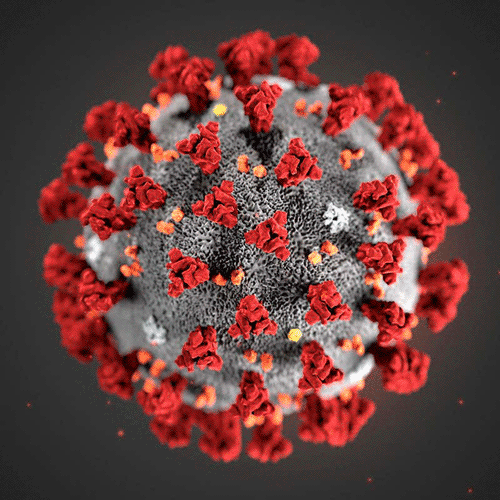
The World Health Organisation (WHO) first learnt of this virus on the 31st of December 2019 — what a way to celebrate the end of the year!
COVID-19 is known as a respiratory pathogen because infection begins in our respiratory system. That is, the organs and tissues that help us breathe. Infection starts when the COVID-19 virus particle inserts a long string of genetic material into a human cell. This genetic material then orders that cell to produce around 30 different parts of the virus. The cell eventually spews out hundreds, if not thousands, of new copies of the virus which go on to infect more cells in your respiratory system. The virus has begun its reproduction.
The virus can be spread when respiratory droplets from an infected person are coughed, sneezed or otherwise expelled (maybe sung) out of the person. The droplets are then propelled through the air where they can infect someone who breathes them in. They can also settle on surfaces leading to spread if someone then touches that surface. Smaller droplets may remain suspended in the air for a long time.
COVID-19 spreads easily among people. If we didn’t do anything about it, one infected person would on average spread it to about 2.2 people. Compare this to the flu where one infected person typically spreads it to about 1.3 people. Importantly, and just like for the flu, about half of this transmission occurs before you develop symptoms, making it difficult to control.
So this is why COVID-19 has spread so quickly. Have a look at this Dashboard of COVID–19 infections put together by WHO.
There is so much we are still finding out about COVID-19. Are you curious to know more about how viruses replicate, and what they do in the body? Or you might want to know more about how COVID-19 impacts different age groups, or different countries? Researchers are working away on these questions so here are some interesting links on these topics.

Approved by Certified COVID Expert,
Professor James McCaw
James McCaw is a mathematical biologist and epidemiologist at the University of Melbourne with interests in infectious diseases. He uses mathematical models and data science techniques to study how viruses and other pathogens infect humans and spread between people. Since January 2020 he has acted as an expert advisor to the Commonwealth of Australia, supporting the national response to COVID-19.